After spending more than 12 years growing dental practices and marketing many events, one thing has become clear: nothing converts curious browsers into committed patients faster than an expertly run open day.
Here, I’ll talk through some of the best industry secrets to running a successful open day – but first, I’ll share some results from open day campaigns we’ve been involved with over the past 12 months:
- One event we were involved in generated over £100,000;
- An implant presentation event had over 40 attendees across two one-hour sessions, generating case enquiries for full mouth restorations;
- The best cosmetic open day event generated 50 attendees.
This wasn’t due to luck (or magic) – it all stemmed from structure. Each practice ran campaigns for around four weeks before the event, targeting a local audience on Facebook and Instagram. This was supported by Google Ads, freshly created landing pages, and email shots. Leads were pre-qualified through a booking form and follow up discussions, and a small deposit was generally required to secure each slot (if they were consultation-led). The practice teams executed the events with precision and used follow-up sequences.
This may sound like a lot of work, but when you have an effective system and structure in place, open days can be surprisingly straightforward – and effective.
Is an open day right for your practice right now?
Like many practices, you might be exploring ways to attract new patients. Perhaps you’re trying to decide whether to channel your budget and energy into an open day or an advertising campaign. And if so, which is better?
The honest answer is: it depends on what you’re trying to achieve. Open days and monthly ad campaigns solve different problems, and running the wrong one at the wrong time could waste the opportunity. So, before committing either way, use the following decision tool.
Choose an open day if…
- You want a concentrated surge of new cases for specific treatments.
- You have diary capacity to absorb a burst of consultations.
- You’re launching or relaunching a high-value treatment or need to hit a target to maintain or achieve a supplier discount.
- You can offer a time-limited incentive (like free whitening or a discount on retainers).
- You want to build your local brand presence quickly.
Choose a monthly campaign if…
- You want a steady, manageable flow of leads.
- Your team may struggle to absorb a sudden influx of consultations.
- You don’t have a TCO role in the practice.
- You’re building long-term awareness over six months or more.
- You don’t want to offer discounts or time-limited deals.
- You’re running campaigns across multiple treatments simultaneously.
Many practices end up running both
In reality, this needn’t be an either-or decision. Many practices choose to run an open day every few months to create a brand awareness boost and a revenue surge, while using monthly campaigns to fill the gaps in between. If you’re scaling cosmetic, orthodontic or implant work, this combination usually delivers the most consistent growth over a 12-month period.
Open days work best for higher-value treatments, such as Invisalign, implants, and cosmetic cases. An on-the-day conversion rate of around 50% is achievable – and when cases are worth £3,500–£15,000+, the maths makes even a modest event very worthwhile.
Planning the event
So, you’re going to run an open day – how should you go about it?
Start with the offer
Your offer is the engine of the campaign. It needs to be attractive enough to get someone to attend, but not so discounted that it devalues your brand position and attracts patients who have no intention of proceeding. The sweet spot is an offer that removes a barrier, rather than purely reducing the price.
Strong open day offers tend to look like this:
- Free consultation and complimentary digital smile assessment (for Invisalign and cosmetic treatments).
- An exclusive package or bundle not available at other times.
- Invisalign with free whitening and retainers included.
- For dental implants, a free and informal expert presentation. This is a softer format, and allows prospective patients to listen as part of a group. You might offer an exclusive clinical assessment discount, available to attendees if booked within 30 days.
- Composite bonding with a same-day discount for patients who commit on the day.
If you’re running an offer, be sure to attach a clear expiry date. This doesn’t need to be aggressive; I recommend phrasing such as “available to patients who attend our open day in [month]”. By adding an expiry, you can effectively make the decision feel real and time-bound, without sounding pushy.
And importantly, don’t try to cover everything. The most successful open days are focused on just one or two treatments. A mixed event dilutes the marketing message and makes the day harder to run. If you have a lot you’d like to cover, you can instead alternate events throughout the year.
Pre-qualify your leads
This is the single biggest differentiator between a busy open day and a profitable one. Pre-qualification means filtering out people who aren’t suitable for treatment before they take up a consultation slot.
- Your booking form or landing page should ask specific questions:
- Their reason for being interested (is it aesthetics, confidence, or a specific concern?).
- What they would like to change.
- Whether they’ve had a recent dental check-up.
- How the typical treatment cost fits with their expectations.
- Whether they’re considering finance.
- If they’re ready to go ahead, or seeking further information as part of the decision-making process.
Being up-front about cost during the booking stage won’t put off serious patients. However, it will put off the ones who were never going to convert – which is exactly the point.
Take a deposit
If you’re booking consultation slots for an event, it’s a good idea to ask for a small deposit to secure the consultation slot, which can be refundable or redeemable against treatment. This single step dramatically reduces no-shows and last-minute cancellations. Alongside this, patients who’ve paid are already slightly invested in the process – which makes the consultation conversation easier. If you’re planning an implant presentation, this step won’t be necessary.
Leverage your existing patients
When you’re thinking about attendees, don’t overlook your current patients. They’re often the highest-converting group at open days, because they already trust you, they know your team, and they’ve been vaguely thinking about that smile makeover for years. Significantly, they’ll also tell their friends. A well-timed email or message inviting them to attend as a priority guest can fill a significant portion of your diary before you’ve spent a penny on ads.
Plan to use your technology and tools
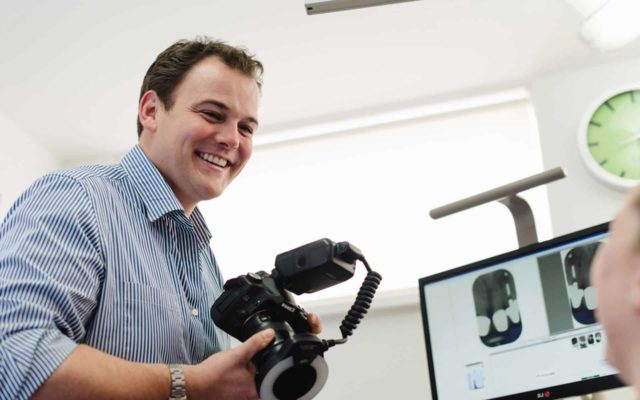
This will be your chance to really impress – and to show prospective patients what makes your practice a great choice. If you’re running an Invisalign event, make sure your iTero scanner and Clincheck capabilities are front and centre. Being able to show a patient a digital simulation of their potential result during the consultation is one of the most powerful conversion tools available. It transforms an abstract discussion into something they can actually see and emotionally connect with.
On the day
Set the scene
Getting your team behind your event makes all the difference. Remember that patients coming to an Invisalign or cosmetic open day are aspirational – they want to feel special. In this, the small things really shine through: considerations like a tidy waiting area, refreshments, and staff who are warm and unhurried.
Make your interactions count
Structure each consultation with a TCO and a clinician playing distinct roles. This means that every patient gets a confident, professional experience. Aim for something like this:
- Welcome and rapport (5 minutes) – greet them by name. Ask what brought them in today. Listen more than you talk.
- Understand their concern (5 minutes) – what bothers them about their smile? What have they tried before? What’s stopped them until now?
- Clinical assessment (10 minutes) – check suitability. If using iTero, run the scan and show them the simulation. This is often the moment patients decide.
- Present the plan (10 minutes) – walk through the treatment, timeline, and cost clearly. Present finance options if relevant. Don’t rush this part.
- The next step (5 minutes) – don’t let them leave without committing to something, even if it’s just booking the next appointment. This is one of the most important things to get right, and it’s where a lot of practices leave money on the table. The most successful practices don’t try to go straight from a free consultation to a £3,500 treatment plan. Instead, they de-risk the journey by breaking it into smaller, manageable steps. Each step builds commitment and makes the next one feel natural. Ultimately, small steps close cases.
Include finance conversations
Bring up finance naturally – not as a last resort, but as part of how you present the treatment plan. You can even use your finance tools (like Tabeo) to give a patient an instant finance decision on a tablet during the consultation. When someone can see a monthly payment figure rather than a lump sum, the decision becomes much more manageable. It also makes the whole process feel real and joined-up.
The key takeaway
If a patient leaves the open day without making any kind of commitment – even a small one – the chances of them converting later drop sharply. Life gets in the way, they start comparing prices online, and the moment passes. A deposit for the next appointment, a date in the diary, and even a finance application started on the day all count. The size of the commitment matters far less than the fact that one was made.
After the event
The event itself is only day one in a much longer process. Following this, there is a 30–90-day follow-up window.
Follow up with attendees
The practices that get the best return on investment are those that treat non-converting attendees as warm leads rather than dead ones. Let’s say half the patients who attend don’t book on the day. This doesn’t mean they’re uninterested – at this point, they’re just undecided. They need more time, more information, or just a well-placed nudge. A structured follow-up sequence is what turns a 50% conversion rate on the day into a 60%+ rate over the following quarter.
Ask for reviews
Finally, don’t forget Google reviews. Ask every attendee, whether they booked or not, to leave a Google review about their experience at the event. Most people won’t, but enough will. A cluster of fresh, genuine reviews in the weeks after an open day has a meaningful impact on your local search visibility and trust signals for future patients researching you.
A note on brand awareness and team morale
Both are genuinely underrated benefits that most practices don’t think about when they’re planning an event. Here’s my view on each:
Brand awareness
An open day does something paid ads never can: it makes your practice physically real to people. A patient who has walked through your door, met your team, and had a conversation in your treatment room has a completely different relationship with your brand than one who only sees you online. That experience sticks.
The ripple effects are also wider than most practices expect. Attendees talk – to their partners, friends, colleagues, and neighbours. During the event, every person in your waiting room represents three or four conversations in the following week. Add in the pre-event social media activity, and the user-generated content from people sharing on the day, and a single event can generate awareness that a month of paid ads couldn’t. The Google review uplift in the weeks afterwards also compounds your local search visibility in a way that’s hard to buy directly.
There’s also a positioning effect. A well-run event signals that your practice is established, confident, and worth serious consideration. That matters in competitive local markets where patients are choosing between three or four practices based on very little information.
Team morale
This one genuinely surprises practice owners. When your clinical team presents their work to an engaged, appreciative audience – patients who are excited about what’s possible, and asking good questions – it positively reconnects them with why they got into dentistry in the first place. Day-to-day clinical work can become routine, whereas an open day is the opposite.
There’s also an element of pride to be found here. Preparing for an event (tidying the practice, refining the consultation process, and presenting their expertise) gives the team something to invest in collectively. The shared experience of a busy, successful open day is genuinely good for culture.
For these reasons, a practice open day isn’t just a means of gaining new patients – it creates a wave of positive effects that ripples through your team, your online presence, and your local reputation. Put simply, when managed well, it’s one of the most effective growth strategies you can adopt.
So, if you’d like to talk through your next event, get in touch.